Frustrated, in short
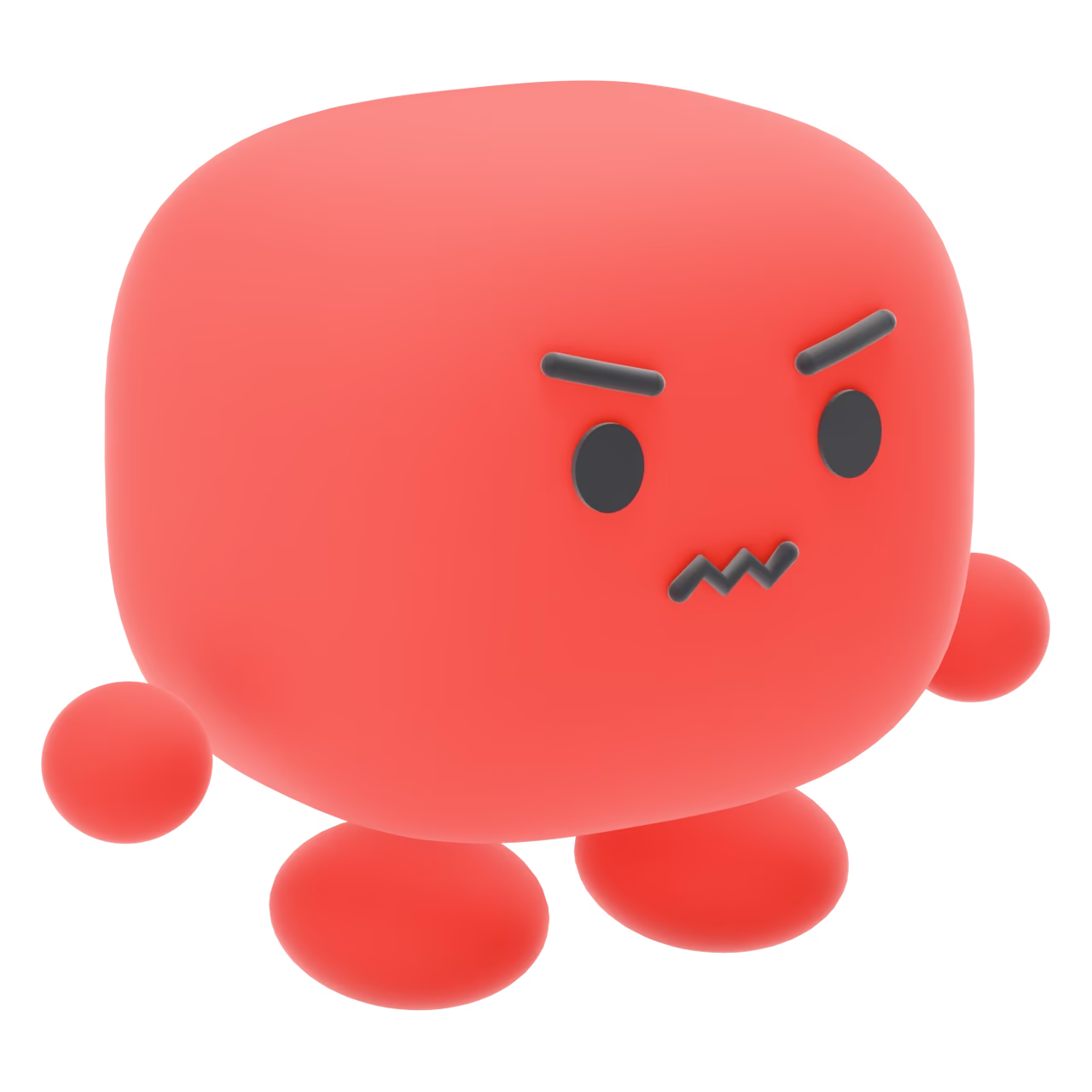
Feeling frustrated means being blocked from something you want or are trying to do. What helps: naming it, cooling your body down before you push again, and stepping back to talk to yourself the way you’d talk to a friend.
The code won’t compile, the form keeps rejecting your answer, the person you need won’t reply. That’s frustration: an uncomfortable feeling, and a very ordinary one.
Why you feel so frustrated
Frustration is close kin to anger. Researchers describe two common sparks for anger: something blocks what you’re trying to do, or something feels unfair. Often it’s both, and a person seems to be in the way (Roseman, 2018). Frustration is the first spark on its own: the feeling of being stuck.
That’s why the two so often blur: being blocked is one of the moments anger is made for.
Can frustration be useful?
Unpleasant feelings have jobs (Keltner and Gross, 1999). Anger, which frustration often sparks, pushes you towards a problem instead of away from it (Carver and Harmon-Jones, 2009).
That push can help when you’re stuck. In one set of experiments, people who had been made angry solved more of the hard word puzzles than people who hadn’t. On the easy puzzles, it made no difference. It helped where there was something to push against. The same project also found anger made people more likely to cheat to win prizes (Lench and colleagues, 2024).
Frustrated, annoyed or angry?
Three feelings that blur into each other, and the app’s line for each:
- Annoyed: mildly bothered or irritated by something.
- Frustrated: blocked from something you want or are trying to do.
- Angry: heated displeasure at something that feels wrong or unfair.
The quickest test is to ask what the feeling is about. Annoyed is about something small that bugs you: a dripping tap, a loud chewer. Frustrated is about a goal and whatever is in its way. Angry has a “that’s not fair” in it, often aimed at someone.
The difference matters more than it looks. People who tell their unpleasant feelings apart tend to handle them better. In one study of 106 young social drinkers, the ones who rated each bad feeling separately drank less on days when bad feelings ran high (Kashdan and colleagues, 2010). “Frustrated” points you at the block. “Angry” points you at a person. Those call for different next steps.
What helps when you’re frustrated
Name it
In brain scans, naming the feeling on an angry or scared face calmed the brain’s alarm area more than naming whether the face was a man’s or a woman’s (Lieberman and colleagues, 2007). Saying “I’m frustrated” out loud, writing it, or picking it from a list all count.
Let it be there
Letting feelings be, without judging them, goes with feeling less upset when stress hits (Ford and colleagues, 2018). “I’m frustrated, and that makes sense” is a fine place to start.
Cool the heat before you push again
If frustration is turning into anger, bring your body down first. A review of 154 studies found calming activities like slow breathing, relaxing your muscles or a time-out lowered anger, while revving-up ones like hitting a bag or cycling didn’t help on average (Kjærvik and Bushman, 2024). Hunger can make anger and irritability come easier too (Swami and colleagues, 2022), so a snack before round two isn’t a silly idea.
Talk to yourself like a friend
It’s easier to see a friend’s problem clearly than your own. In three experiments, people reasoned more wisely about someone else’s conflict than their own, and when asked to step back from their own problem, the gap disappeared (Grossmann and Kross, 2014). One way to step back: use your own name or “you”. In studies of stressful moments like giving a speech, people who did felt less distressed and performed better (Kross and colleagues, 2014). “Okay, Sam, what’s actually blocking you?”
Don’t carry it around all day
Replaying what happened keeps feelings like anger going (Verduyn and colleagues, 2009). In one study, students who chewed on an insult all day were more aggressive hours later towards someone new, after a slightly snippy comment (Bushman and colleagues, 2005). That’s one way a bad afternoon ends up landing on someone who had nothing to do with it.
Journal prompts for frustration
Frustration is about a block, so these keep coming back to it. Pick one or two.
Notice
- What exactly are you trying to do right now?
- What’s in the way: a thing, a person, a rule, or the clock?
- Where do you feel the frustration in your body?
- Is it still frustration, or is it starting to turn into anger?
Understand
- How long have you been pushing at this?
- Why does getting past this block matter to you?
- Is the block something you can change, or something you have to work around?
- What would you tell a friend who was stuck on exactly this?
Act
- What’s the smallest next step that gets you around the block?
- Would a break, a snack or a few slow breaths help before round two?
- Who could help unblock it, or might know a way around?
- What can you set down for today?
- What will you do so it doesn’t follow you into the evening?
Frustration in Feelbits
Stuck on something? Tap Frustrated in Feelbits; that’s the check-in, and you can add what’s in the way or a journal line if you like. The Learn path Keep your cool covers the anger side of this, one short lesson at a time, and How to name your feelings has more on finding the right word. If the heat has already taken over, the page on feeling Angry has more.
When it’s more than everyday frustration
If frustration often boils over into anger that feels out of control, or it gets in the way of daily life most days, it’s worth talking to a doctor or therapist.
Angry for no reason? Why you feel so irritable What to say to someone who is frustrated
Frustrated, or something close?
Guides for when you feel frustrated
Not sure which word fits? Try the feeling word finder.
Sources
- Roseman, I. J. (2018). Functions of anger in the emotion system. In H. C. Lench (Ed.), The Function of Emotions (pp. 141–173). Springer. doi.org/10.1007/978-3-319-77619-4_8
- Keltner, D., & Gross, J. J. (1999). Functional accounts of emotions. Cognition & Emotion, 13(5), 467–480. doi.org/10.1080/026999399379140
- Carver, C. S., & Harmon-Jones, E. (2009). Anger is an approach-related affect: Evidence and implications. Psychological Bulletin, 135(2), 183–204. doi.org/10.1037/a0013965
- Lench, H. C., Reed, N. T., George, T., Kaiser, K. A., & North, S. G. (2024). Anger has benefits for attaining goals. Journal of Personality and Social Psychology, 126(4), 587–602. doi.org/10.1037/pspa0000350
- Kashdan, T. B., Ferssizidis, P., Collins, R. L., & Muraven, M. (2010). Emotion differentiation as resilience against excessive alcohol use: An ecological momentary assessment in underage social drinkers. Psychological Science, 21(9), 1341–1347. doi.org/10.1177/0956797610379863
- Lieberman, M. D., et al. (2007). Putting feelings into words. Psychological Science, 18(5), 421–428. doi.org/10.1111/j.1467-9280.2007.01916.x
- Ford, B. Q., Lam, P., John, O. P., & Mauss, I. B. (2018). The psychological health benefits of accepting negative emotions and thoughts: Laboratory, diary, and longitudinal evidence. Journal of Personality and Social Psychology, 115(6), 1075–1092. doi.org/10.1037/pspp0000157
- Kjærvik, S. L., & Bushman, B. J. (2024). A meta-analytic review of anger management activities that increase or decrease arousal: What fuels or douses rage? Clinical Psychology Review, 109, 102414. doi.org/10.1016/j.cpr.2024.102414
- Swami, V., Hochstöger, S., Kargl, E., & Stieger, S. (2022). Hangry in the field: An experience sampling study on the impact of hunger on anger, irritability, and affect. PLoS ONE, 17(7), e0269629. doi.org/10.1371/journal.pone.0269629
- Grossmann, I., & Kross, E. (2014). Exploring Solomon's paradox: Self-distancing eliminates the self-other asymmetry in wise reasoning about close relationships in younger and older adults. Psychological Science, 25(8), 1571–1580. doi.org/10.1177/0956797614535400
- Kross, E., Bruehlman-Senecal, E., Park, J., Burson, A., Dougherty, A., Shablack, H., Bremner, R., Moser, J., & Ayduk, O. (2014). Self-talk as a regulatory mechanism: How you do it matters. Journal of Personality and Social Psychology, 106(2), 304–324. doi.org/10.1037/a0035173
- Verduyn, P., Delvaux, E., Van Coillie, H., Tuerlinckx, F., & Van Mechelen, I. (2009). Predicting the duration of emotional experience: Two experience sampling studies. Emotion, 9(1), 83–91. doi.org/10.1037/a0014610
- Bushman, B. J., Bonacci, A. M., Pedersen, W. C., Vasquez, E. A., & Miller, N. (2005). Chewing on it can chew you up: Effects of rumination on triggered displaced aggression. Journal of Personality and Social Psychology, 88(6), 969–983. doi.org/10.1037/0022-3514.88.6.969