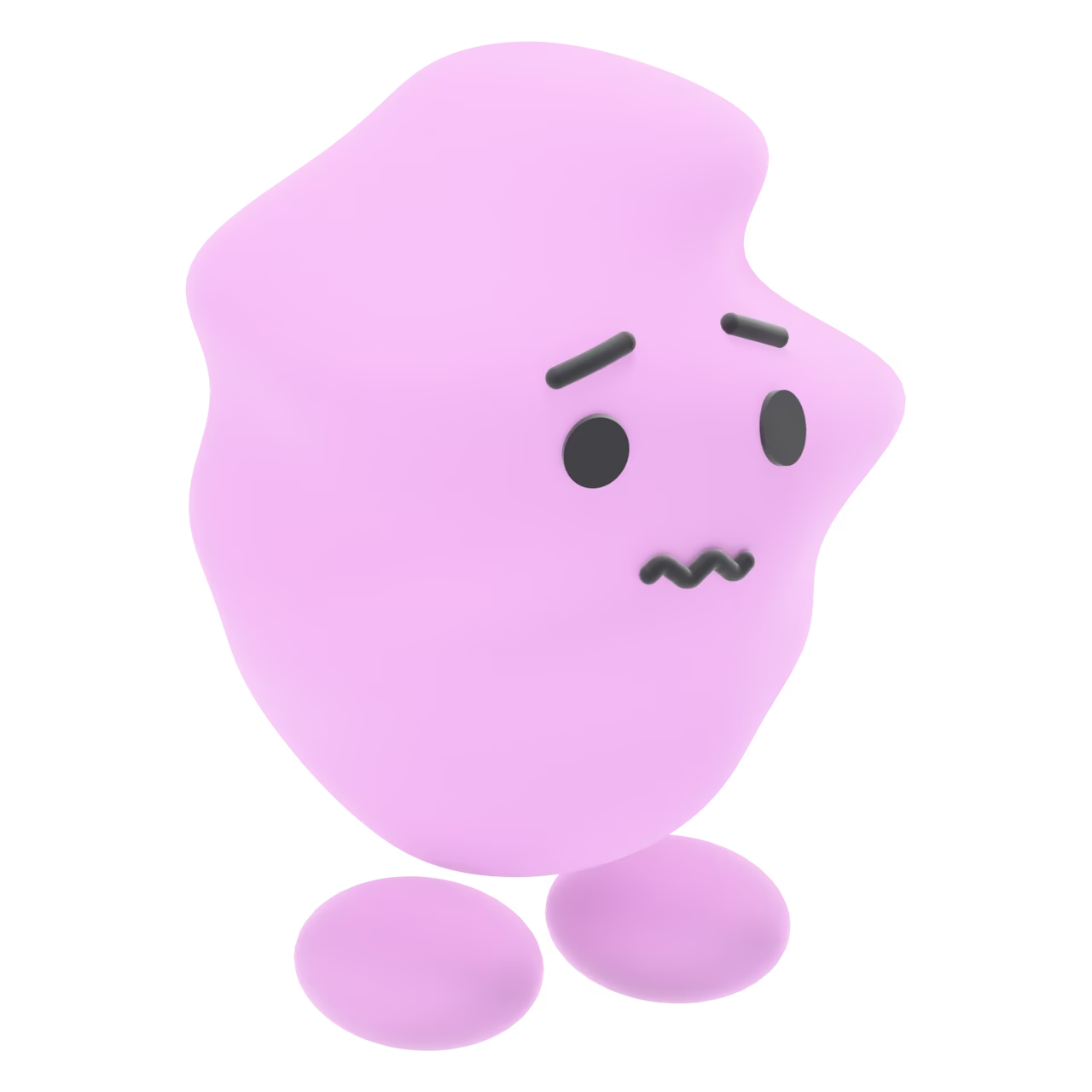
Anxious, in short
Feeling anxious means feeling uneasy about something that might go wrong. What helps: naming it, breathing out longer than you breathe in, and checking the worry against what really happens.
Nothing bad is happening yet, but your brain’s alarm has gone off for a maybe: the meeting on Monday, the message nobody has answered.
Feelbits puts it as “uneasy about something that might go wrong”. Most of what’s below comes from the research I read for the app’s Learn lessons.
What anxiety is for
Your brain has a built-in alarm, and psychologists often split its work in two. Fear is for a threat that’s here right now. Anxiety is for one that might come.
The alarm is jumpy on purpose. Think of a smoke alarm: a false alarm costs a few annoying seconds, and a missed fire could cost everything. The researcher Randolph Nesse calls this the smoke detector principle (Nesse, 2005). So feeling anxious doesn’t mean something is wrong with you. An alarm that sometimes rings for toast is still a working alarm.
It’s also very common. In an app study of more than 11,000 people, anxiety came up in 29% of random moments, just behind joy and love (Trampe, Quoidbach and Taquet, 2015).
Often the hardest part is not knowing. In a study at University College London, 45 adults played a game where a snake hidden under a rock meant a painful shock. Their stress peaked when a snake was anyone’s guess, not when a shock was likely (de Berker and colleagues, 2016).
How anxiety feels in your body
A racing heart, quick breathing, a fluttery stomach. That’s your fight-or-flight system: when your brain picks up a possible threat, adrenaline gets your body ready to act, sometimes before you’ve fully taken in what’s happening. It fires for things that aren’t life-threatening too, like a traffic jam or pressure at work (Harvard Health Publishing, 2024).
The butterflies are real too: the alarm slows digestion and sends blood towards your muscles, and your gut has its own network of 200 to 600 million nerve cells that can notice (Furness and colleagues, 2014).
Researchers have also asked people where they feel it. In body-map studies, people colour a blank body outline to show where they feel a feeling, and for anxiety they mark the chest and head (Vik and colleagues, 2026). A study of 588 high-school students in China found the same for anxiety about schoolwork: more activity in the head and chest (Zhong and colleagues, 2026). These maps show where people say they feel it, not what a machine measured.
Anxious, scared or stressed?
Four feelings that often get lumped together as “nervous”, with Feelbits’ meanings:
- Anxious: uneasy about something that might go wrong.
- Scared: sensing danger and wanting to get away from it.
- Stressed: under pressure, with too much being asked of you.
- Overwhelmed: so much is going on that it feels like too much to handle.
A quick way to tell: if the danger is right in front of you, it’s closer to scared. If it’s a maybe, it’s anxious. If it’s a pile of things to do rather than a threat, it’s more likely stressed or overwhelmed.
A pounding heart before something you want might be excitement instead: nerves and excitement rev up the body in much the same way.
Four ways to turn the alarm down
Four things in short (the longer list is in What to do when you feel anxious):
Name it
Putting a feeling into words can settle the body. In one study, people afraid of spiders who put the feeling into words had the calmest bodies a week later, though they didn’t say they felt less afraid (Kircanski, Lieberman and Craske, 2012).
Breathe out longer than you breathe in
Your heart speeds up a little on each breath in and slows down on each breath out (Yasuma and Hayano, 2004). In a month-long study at Stanford, every practice tested left people less anxious after each session, and the cyclic sigh (two breaths in, one long breath out) gave the biggest lift in mood (Balban and colleagues, 2023).
Check the worry
A worry is a guess about what might go wrong, and guesses can be checked. In a study of 29 students with generalized anxiety disorder, about 9 in 10 of their worries never came true (LaFreniere and Newman, 2020).
Stay and see
Avoiding the thing you dread brings quick relief, and that relief can keep the fear alive. In a lab study, people who used a safety move on a harmless shape kept expecting a shock after it (van Dis and colleagues, 2022). The nerves can stay the whole time. What teaches the alarm is seeing what actually happens.
Questions to write through a worry
Start with whichever question grabs you. A line or two each is plenty.
Notice
- What exactly are you worried might happen?
- Is it happening right now, or is it a maybe?
- Where do you feel it: chest, stomach, shoulders, somewhere else?
- What were you doing or thinking about just before the unease started?
- How loud is the alarm right now, from 1 to 10?
Understand
- What’s the worst, the best and the most likely way this could go?
- The last time you worried about something like this, what actually happened?
- What does this worry care about? What is it trying to protect?
- Are you avoiding something because of it, and what is that costing you?
- Is this something you can do anything about, or is it out of your hands?
Act
- What’s one small step you could take on this today?
- Could you take a few breaths, each out longer than in, before you decide anything?
- What would you tell a friend who had this worry?
- Who could you tell about it?
- When could you check back to see whether the worry came true?
Anxious in Feelbits
When the alarm goes off, a check-in takes seconds: turn the dial in Feelbits, tap Anxious, and the feeling has a name. A little Anxious Feelbit joins your village. If you like, write the worry in the journal line. Calm the alarm, the Learn path about anxiety, goes deeper into most of this, one short lesson at a time.
When it’s more than everyday anxiety
This page is about the everyday kind. If anxiety gets in the way of your daily life most days, it’s worth talking to a doctor or therapist. You don’t have to sort it out on your own.
Journal prompts for when you feel anxious Words to describe feeling anxious Sunday scaries: why Sunday evenings feel heavy Anxious before work: why mornings feel tense Anxious at night: why it gets louder in bed Anxious in the morning: why you wake up with it Anxious after drinking: why hangxiety happens Nervous before a presentation: what helps What to say to someone who is anxious What to say to someone having a panic attack
Anxious, or something close?
Guides for when you feel anxious
- What to do when you feel anxious: 7 things that help
- Journaling for your feelings: how to start and what to write
- What is emotional granularity? Telling your feelings apart
- Affect labeling: what “name it to tame it” means
- Take a feeling apart: body, read, urge
- Where do you feel it? A 1-minute body check for feelings
- Cyclic sighing: a 5-minute breathing practice to calm down
- Do your worries come true? Try a worry log
Not sure which word fits? Try the feeling word finder.
Sources
- Nesse, R. M. (2005). Natural selection and the regulation of defenses: A signal detection analysis of the smoke detector principle. Evolution and Human Behavior, 26(1), 88–105. doi.org/10.1016/j.evolhumbehav.2004.08.002
- Trampe, D., Quoidbach, J., & Taquet, M. (2015). Emotions in everyday life. PLoS ONE, 10(12), e0145450. doi.org/10.1371/journal.pone.0145450
- de Berker, A. O., Rutledge, R. B., Mathys, C., Marshall, L., Cross, G. F., Dolan, R. J., & Bestmann, S. (2016). Computations of uncertainty mediate acute stress responses in humans. Nature Communications, 7, 10996. doi.org/10.1038/ncomms10996
- Harvard Health Publishing (2024, April 3). Understanding the stress response. Harvard Medical School. www.health.harvard.edu/staying-healthy/understanding-the-stress-response
- Furness, J. B., Callaghan, B. P., Rivera, L. R., & Cho, H.-J. (2014). The enteric nervous system and gastrointestinal innervation: Integrated local and central control. Advances in Experimental Medicine and Biology, 817, 39–71. doi.org/10.1007/978-1-4939-0897-4_3
- Vik, A., Galvez-Pol, A., Park, S., & Tsakiris, M. (2026). Politics embodied: How politics shapes and is shaped by the bodily experience of emotions. Proceedings of the National Academy of Sciences, 123(20), e2534895123. doi.org/10.1073/pnas.2534895123
- Zhong, S., Tang, X., Cheng, X., & Pan, Y. (2026). Bodily maps of subject-specific feelings and academic emotions among high school students. BMC Psychology, 14, 499. doi.org/10.1186/s40359-026-04283-1
- Kircanski, K., Lieberman, M. D., & Craske, M. G. (2012). Feelings into words. Psychological Science, 23(10), 1086–1091. doi.org/10.1177/0956797612443830
- Yasuma, F., & Hayano, J. (2004). Respiratory sinus arrhythmia: Why does the heartbeat synchronize with respiratory rhythm? Chest, 125(2), 683–690. doi.org/10.1378/chest.125.2.683
- Balban, M. Y., Neri, E., Kogon, M. M., Weed, L., Nouriani, B., Jo, B., Holl, G., Zeitzer, J. M., Spiegel, D., & Huberman, A. D. (2023). Brief structured respiration practices enhance mood and reduce physiological arousal. Cell Reports Medicine, 4(1), 100895. doi.org/10.1016/j.xcrm.2022.100895
- LaFreniere, L. S., & Newman, M. G. (2020). Exposing worry's deceit: Percentage of untrue worries in generalized anxiety disorder treatment. Behavior Therapy, 51(3), 413–423. doi.org/10.1016/j.beth.2019.07.003
- van Dis, E. A. M., Krypotos, A.-M., Zondervan-Zwijnenburg, M. A. J., Tinga, A. M., & Engelhard, I. M. (2022). Safety behaviors toward innocuous stimuli can maintain or increase threat beliefs. Behaviour Research and Therapy, 156, 104142. doi.org/10.1016/j.brat.2022.104142