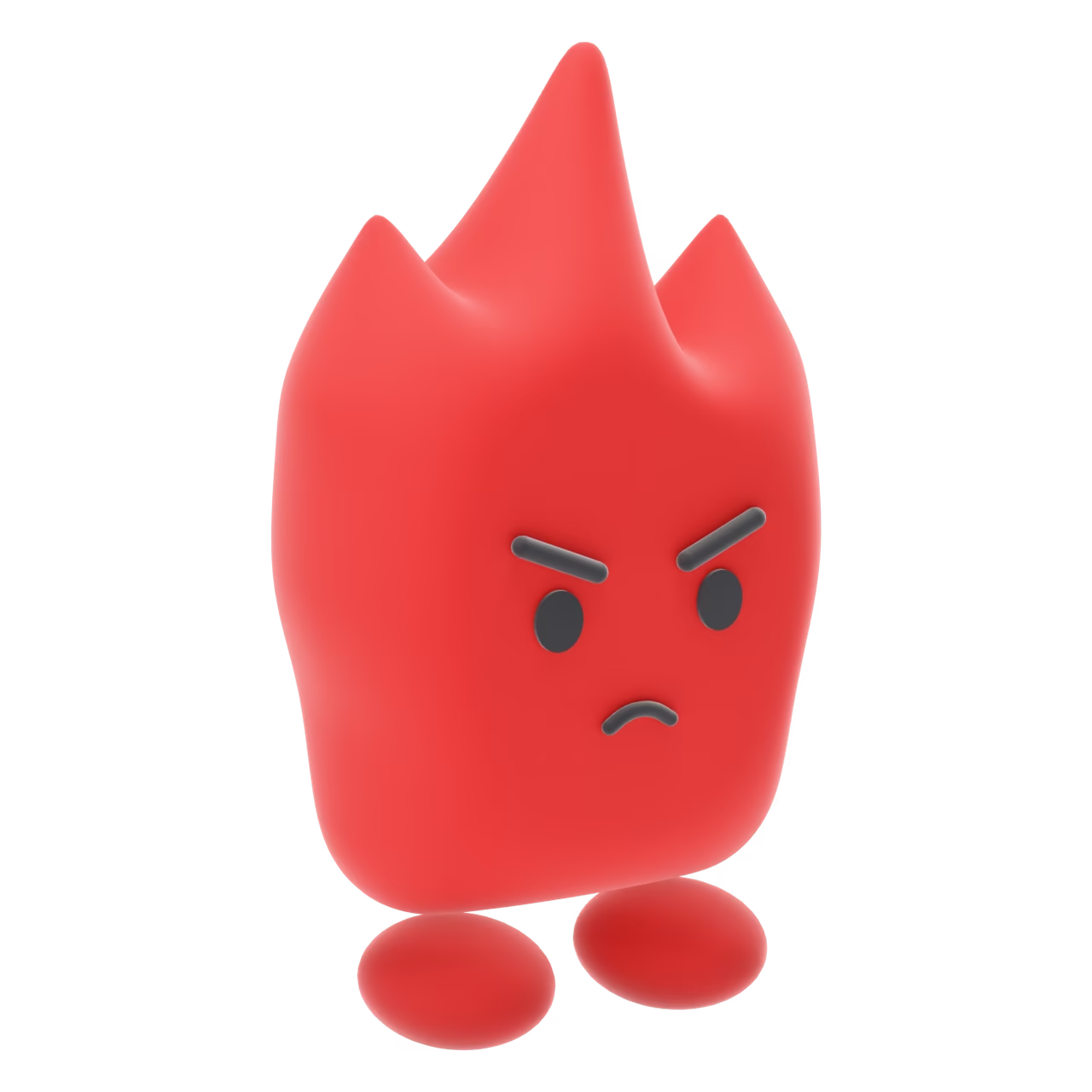
Angry, in short
Feeling angry means feeling heated displeasure at something that feels wrong or unfair. What helps: calming your body with slow breathing or a time-out, checking your read of what happened, and not replaying it over and over.
Anger is a normal feeling with a job: it pushes you towards a problem. The feeling isn’t the trouble. What you do with the push is.
What anger is for
Anger tends to show up for two reasons. Something blocks what you’re trying to do, or something feels unfair. Often it’s both, and a person seems to be in the way (Roseman, 2018).
Psychologists call anger an approach feeling. Fear pulls you away from a problem. Anger pushes you towards it (Carver and Harmon-Jones, 2009).
That push can help. In one set of experiments, people who looked through pictures chosen to make them angry solved more of the hard word puzzles than people who saw neutral pictures. On the easy puzzles, anger made no difference. But in another task from the same project, anger also made people more likely to cheat to win prizes (Lench and colleagues, 2024). Anger adds push. It doesn’t pick the direction.
How anger feels in your body
Anger revs the body up. In a classic study, hearts sped up about as much when people held an angry face as a scared one, and only the angry face clearly warmed their fingers, by about a tenth of a degree Celsius (Ekman, Levenson and Friesen, 1983). The pattern isn’t the same every time, though (Siegel and colleagues, 2018).
A team in Finland asked about 700 people to colour two blank body outlines: one where they felt activity getting stronger, one where it got weaker. Anger lit up the head and chest, as most feelings did. What set it apart was the arms: anger and happiness were the feelings people placed most in their arms (Nummenmaa and colleagues, 2014). A study of 91 adults in Italy found the same, especially in the hands: the parts you use to act (Novembre and colleagues, 2019). Maps from 3,954 people in 101 countries were very similar across cultures (Volynets and colleagues, 2020). The maps show what people reported feeling, not measurements of the body.
Anger comes in a wave: it rises, peaks and eases off. In two daily-report studies, feelings like anger lasted longer when the trigger came back, in real life or just in thought (Verduyn and colleagues, 2009).
Angry, annoyed or furious?
How Feelbits puts each of the four in one line:
- Annoyed: mildly bothered or irritated by something.
- Angry: heated displeasure at something that feels wrong or unfair.
- Furious: intensely angry, close to boiling over.
- Frustrated: blocked from something you want or are trying to do.
A quick way to tell them apart: annoyed is a pebble in your shoe. Angry has a “that’s not fair” in it. Furious is angry with the volume all the way up. And frustrated is about being stuck, one of anger’s two common sparks.
What helps when you’re angry
Bring your body down, not up
“Let it all out” sounds right, but it doesn’t hold up. In one well-known study, 600 students got a harsh insult on an essay. Those who then hit a punching bag while picturing the insulter felt the angriest and were the most aggressive. Sitting quietly for two minutes worked better (Bushman, 2002).
A 2024 review pooled 154 studies with over 10,000 people. Calming things like slow breathing, relaxing your muscles or taking a time-out lowered anger. Revving-up things like hitting a bag or cycling didn’t help on average (Kjærvik and Bushman, 2024). Try 30 seconds of breathing in for 4 and out for 6. That’s about six breaths a minute, the slow range linked with feeling more relaxed and less angry (Zaccaro and colleagues, 2018).
Check your read
Harm stings more when it seems deliberate. In one study, identical electric shocks were rated as more painful when a partner seemed to give them on purpose (Gray and Wegner, 2008). When people were hungrier, they also felt angrier and more irritable (Swami and colleagues, 2022), and people who cut their sleep for two nights got angrier at an irritating noise (Krizan and Hisler, 2019). Sometimes the fix is a snack or an early night.
Stop replaying it
Going over it again and again keeps the wave going. Students who chewed on an insult all day were more aggressive hours later towards someone new, whose only offence was a slightly snippy comment (Bushman and colleagues, 2005).
Zoom out
Watching the moment from a distance, like a fly on the wall, left people less angry and less aggressive. Replaying it through their own eyes didn’t help (Mischkowski, Kross and Bushman, 2012). Cooling down this way isn’t the same as swallowing it.
Say it clearly
When you do speak up, how you start matters. Students rated opening lines that began with “I” as less likely to make the other person defensive than lines aimed at “you”. Lines that also showed the other person’s side did best (Rogers, Howieson and Neame, 2018).
Questions to write through anger
For when the heat has dropped a little. One honest answer beats five rushed ones.
Notice
- Where do you feel the anger right now: chest, arms, hands, somewhere else?
- Somewhere between annoyed and furious, where is it?
- Which thought keeps coming back?
- What does the anger want you to do right now?
Understand
- What happened just before it started?
- What felt wrong or unfair about it?
- Did they mean it, or could there be another reading?
- Are you hungry, tired or short on sleep today?
- When this has happened before, what did those times have in common?
Act
- What would bring your body down a notch in the next five minutes?
- If you watched the moment from across the room, what would you see?
- What do you want the other person to understand, and how could you start that with “I”?
- Does this need saying now, later, or not at all?
- Who could you talk it through with first?
Anger in Feelbits
When I wrote the lessons for Keep your cool, the Learn path about anger, it came down to three things: cool your body, check your read, say it clearly. In the app, tapping Angry is the check-in, and the Angry Feelbit joins your village. You can add a line to the journal too, like what set it off. Even that small step of naming it counts, as How to name your feelings explains.
When anger is more than everyday anger
If anger often feels out of control, or turns into hurting other people or yourself, talking to a doctor or therapist is worth it. You don’t have to sort that out on your own.
Journal prompts for when you feel angry Words to describe feeling angry Angry for no reason? Why you feel so irritable What to say to someone who is angry
Angry, or something close?
Guides for when you feel angry
Not sure which word fits? Try the feeling word finder.
Sources
- Roseman, I. J. (2018). Functions of anger in the emotion system. In H. C. Lench (Ed.), The Function of Emotions (pp. 141–173). Springer. doi.org/10.1007/978-3-319-77619-4_8
- Carver, C. S., & Harmon-Jones, E. (2009). Anger is an approach-related affect: Evidence and implications. Psychological Bulletin, 135(2), 183–204. doi.org/10.1037/a0013965
- Lench, H. C., Reed, N. T., George, T., Kaiser, K. A., & North, S. G. (2024). Anger has benefits for attaining goals. Journal of Personality and Social Psychology, 126(4), 587–602. doi.org/10.1037/pspa0000350
- Ekman, P., Levenson, R. W., & Friesen, W. V. (1983). Autonomic nervous system activity distinguishes among emotions. Science, 221(4616), 1208–1210. doi.org/10.1126/science.6612338
- Siegel, E. H., Sands, M. K., Van den Noortgate, W., Condon, P., Chang, Y., Dy, J., Quigley, K. S., & Barrett, L. F. (2018). Emotion fingerprints or emotion populations? A meta-analytic investigation of autonomic features of emotion categories. Psychological Bulletin, 144(4), 343–393. doi.org/10.1037/bul0000128
- Nummenmaa, L., Glerean, E., Hari, R., & Hietanen, J. K. (2014). Bodily maps of emotions. Proceedings of the National Academy of Sciences, 111(2), 646–651. doi.org/10.1073/pnas.1321664111
- Novembre, G., Zanon, M., Morrison, I., & Ambron, E. (2019). Bodily sensations in social scenarios: Where in the body? PLOS ONE, 14(6), e0206270. doi.org/10.1371/journal.pone.0206270
- Volynets, S., Glerean, E., Hietanen, J. K., Hari, R., & Nummenmaa, L. (2020). Bodily maps of emotions are culturally universal. Emotion, 20(7), 1127–1136. doi.org/10.1037/emo0000624
- Verduyn, P., Delvaux, E., Van Coillie, H., Tuerlinckx, F., & Van Mechelen, I. (2009). Predicting the duration of emotional experience: Two experience sampling studies. Emotion, 9(1), 83–91. doi.org/10.1037/a0014610
- Bushman, B. J. (2002). Does venting anger feed or extinguish the flame? Catharsis, rumination, distraction, anger, and aggressive responding. Personality and Social Psychology Bulletin, 28(6), 724–731. doi.org/10.1177/0146167202289002
- Kjærvik, S. L., & Bushman, B. J. (2024). A meta-analytic review of anger management activities that increase or decrease arousal: What fuels or douses rage? Clinical Psychology Review, 109, 102414. doi.org/10.1016/j.cpr.2024.102414
- Zaccaro, A., Piarulli, A., Laurino, M., Garbella, E., Menicucci, D., Neri, B., & Gemignani, A. (2018). How breath-control can change your life: A systematic review on psycho-physiological correlates of slow breathing. Frontiers in Human Neuroscience, 12, 353. doi.org/10.3389/fnhum.2018.00353
- Gray, K., & Wegner, D. M. (2008). The sting of intentional pain. Psychological Science, 19(12), 1260–1262. doi.org/10.1111/j.1467-9280.2008.02208.x
- Swami, V., Hochstöger, S., Kargl, E., & Stieger, S. (2022). Hangry in the field: An experience sampling study on the impact of hunger on anger, irritability, and affect. PLoS ONE, 17(7), e0269629. doi.org/10.1371/journal.pone.0269629
- Krizan, Z., & Hisler, G. (2019). Sleepy anger: Restricted sleep amplifies angry feelings. Journal of Experimental Psychology: General, 148(7), 1239–1250. doi.org/10.1037/xge0000522
- Bushman, B. J., Bonacci, A. M., Pedersen, W. C., Vasquez, E. A., & Miller, N. (2005). Chewing on it can chew you up: Effects of rumination on triggered displaced aggression. Journal of Personality and Social Psychology, 88(6), 969–983. doi.org/10.1037/0022-3514.88.6.969
- Mischkowski, D., Kross, E., & Bushman, B. J. (2012). Flies on the wall are less aggressive: Self-distancing \"in the heat of the moment\" reduces aggressive thoughts, angry feelings and aggressive behavior. Journal of Experimental Social Psychology, 48(5), 1187–1191. doi.org/10.1016/j.jesp.2012.03.012
- Rogers, S. L., Howieson, J., & Neame, C. (2018). I understand you feel that way, but I feel this way: The benefits of I-language and communicating perspective during conflict. PeerJ, 6, e4831. doi.org/10.7717/peerj.4831