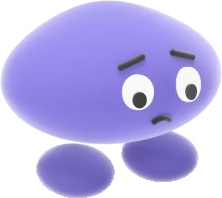
Disappointed means you’re let down because something didn’t turn out as you hoped: the job, the trip, the evening you’d looked forward to all week. Sad is heavier and comes after a loss or something that hurt, like someone leaving or something ending.
A missed hope, or a loss
“Sad” often gets used for both. The app keeps them apart:
- Disappointed: let down when something did not turn out as hoped.
- Sad: heavy and down because of a loss or something that hurt.
Disappointment needs a hope to start from. Researchers who study it describe it as the feeling that comes when an outcome doesn’t live up to what you expected (Zeelenberg and colleagues, 2000). You can’t be let down by something you never hoped for.
Sad is the heavier of the two, and you can feel it in the body. When 701 people coloured in body outlines to show where they felt different feelings, sadness drained from the arms and legs (Nummenmaa and colleagues, 2014).
How long each one lasts
In one study, 233 high school students recalled recent episodes of feelings from a list of 27 and said how long each lasted. Sadness lasted longest, clearly longer than every other feeling on the list, disappointment included. The feelings that lasted long were usually about things that mattered a lot, and came with more going over it in your head (Verduyn and Lavrijsen, 2015).
Looking back, or slowing down
Disappointment points at a hope. In gambling experiments, results people didn’t see coming had a bigger impact than ones they expected, and any result felt worse when a better one had been possible (Mellers and colleagues, 1997). So disappointment looks back at what could have been. It’s also a sign that something mattered to you.
Sadness points at a loss. Researchers who study why we have feelings see each one as having a job to do. Sadness slows you down after a loss (Keltner and Gross, 1999). Feeling sad after a loss isn’t a sign you’re getting something wrong.
Getting through each
After a letdown
- Name it. Putting a feeling into words turns the brain’s alarm down a notch (Lieberman and colleagues, 2007). “Disappointed” also tells you more than “bad”: it points at the hope that didn’t work out.
- Don’t keep replaying it. In daily-report studies, a feeling lasted longer when the thing that set it off came back, even just in people’s heads (Verduyn and colleagues, 2009).
- You may bounce back sooner than you think. In six studies, people overestimated how long they would feel bad after things like a breakup or a rejection from an employer (Gilbert and colleagues, 1998).
After a loss
- Don’t rush it. Sadness doesn’t always need fixing. Letting feelings be without judging them goes with feeling less upset when stress hits (Ford and colleagues, 2018).
- Talk to someone. The NHS’s tips for low mood start with talking about your feelings to a friend, family member, healthcare professional or counsellor (NHS, 2026).
Disappointed vs sad at a glance
| Disappointed | Sad | |
|---|---|---|
| What sets it off | A hope that didn’t work out | A loss, or something that hurt |
| In the body | Not as heavy as sadness | Heavy, drained in the arms and legs |
| Thoughts | “I hoped for more” | Missing what’s gone |
| The urge | Look back at what could have been | Slow down |
| What helps | Naming it, not replaying it | Letting it be, talking to someone |
Which one to tap in Feelbits
Disappointed and Sad each have their own Feelbit, and either tap is a check-in. Telling them apart is more than wordplay. In a three-week study of 106 young social drinkers, on days when bad feelings ran high, the ones who told those feelings apart drank less (Kashdan and colleagues, 2010). The Learn path How feelings work has short lessons on naming feelings and finding the closest word. If the letdown is more about being blocked while you’re still trying, see Frustrated vs disappointed.
When the low doesn’t lift
The NHS says a low mood often gets better after a few days or weeks, and that a low mood lasting 2 weeks or more could be a sign of depression (NHS, 2026). If it gets in the way of daily life most days, it’s worth talking to a doctor or therapist. Sad vs depressed has more. If it all feels like too much right now, findahelpline.com lists free, confidential helplines in your country. If you might hurt yourself or you’re in danger, call your local emergency number (112 in Europe, 911 in the US).
Sources
- Zeelenberg, M., van Dijk, W. W., Manstead, A. S. R., & van der Pligt, J. (2000). On bad decisions and disconfirmed expectancies: The psychology of regret and disappointment. Cognition and Emotion, 14(4), 521–541. doi.org/10.1080/026999300402781
- Nummenmaa, L., Glerean, E., Hari, R., & Hietanen, J. K. (2014). Bodily maps of emotions. Proceedings of the National Academy of Sciences, 111(2), 646–651. doi.org/10.1073/pnas.1321664111
- Verduyn, P., & Lavrijsen, S. (2015). Which emotions last longest and why: The role of event importance and rumination. Motivation and Emotion, 39(1), 119–127. doi.org/10.1007/s11031-014-9445-y
- Mellers, B. A., Schwartz, A., Ho, K., & Ritov, I. (1997). Decision affect theory: Emotional reactions to the outcomes of risky options. Psychological Science, 8(6), 423–429. doi.org/10.1111/j.1467-9280.1997.tb00455.x
- Keltner, D., & Gross, J. J. (1999). Functional accounts of emotions. Cognition & Emotion, 13(5), 467–480. doi.org/10.1080/026999399379140
- Lieberman, M. D., et al. (2007). Putting feelings into words. Psychological Science, 18(5), 421–428. doi.org/10.1111/j.1467-9280.2007.01916.x
- Verduyn, P., Delvaux, E., Van Coillie, H., Tuerlinckx, F., & Van Mechelen, I. (2009). Predicting the duration of emotional experience: Two experience sampling studies. Emotion, 9(1), 83–91. doi.org/10.1037/a0014610
- Gilbert, D. T., Pinel, E. C., Wilson, T. D., Blumberg, S. J., & Wheatley, T. P. (1998). Immune neglect: A source of durability bias in affective forecasting. Journal of Personality and Social Psychology, 75(3), 617–638. doi.org/10.1037/0022-3514.75.3.617
- Ford, B. Q., Lam, P., John, O. P., & Mauss, I. B. (2018). The psychological health benefits of accepting negative emotions and thoughts: Laboratory, diary, and longitudinal evidence. Journal of Personality and Social Psychology, 115(6), 1075–1092. doi.org/10.1037/pspp0000157
- NHS. (2026). Get help with low mood, sadness or depression. National Health Service. www.nhs.uk/mental-health/feelings-symptoms-behaviours/feelings-and-symptoms/low-mood-sadness-depression/
- Kashdan, T. B., Ferssizidis, P., Collins, R. L., & Muraven, M. (2010). Emotion differentiation as resilience against excessive alcohol use: An ecological momentary assessment in underage social drinkers. Psychological Science, 21(9), 1341–1347. doi.org/10.1177/0956797610379863