
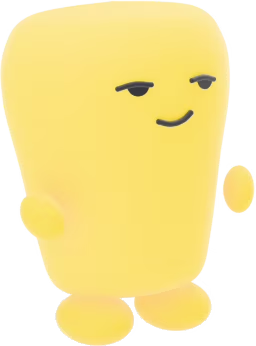
Pride looks back: you’re pleased with something you, or someone close to you, already did. Confidence looks ahead: you trust yourself to handle whatever comes next.
Done, or still ahead
Both are good feelings about yourself, and they often turn up together. The difference is which way they face. Pride needs something that already happened: the exam passed, the shelf built, the hard conversation finally had. Confidence doesn’t need anything yet. It’s about what’s in front of you. Feelbits gives them these lines:
- Proud: pleased with something you or someone close to you did.
- Confident: trusting yourself to handle what comes.
Pride can be about other people too, like your friend’s first marathon or your little brother’s school play. Confidence is about you: can I handle this?
You can often see pride before anyone says a word. Its best-known look is a small smile, an expanded posture, the head tilted slightly, and arms raised or hands on hips (Tracy and Robins, 2007).
How pride feeds confidence
Pride tells you that you did something worth doing. Psychologists Jessica Tracy and Richard Robins suggest it may signal that you’ve done something others will value, and the good feeling makes you want to do it again (Tracy and Robins, 2007). It also seems to keep you going. In a lab study, students who got warm praise for a tricky task felt prouder, and kept going longer at a tedious follow-up task they believed was linked to the first (Williams and DeSteno, 2008).
Confidence tells you that you’re ready. The psychologist Albert Bandura called this belief self-efficacy: your sense that you can do what a situation asks of you. He suggested it shapes whether you start something hard, how much effort you put in, and how long you keep going when it gets tough (Bandura, 1977).
Here’s where the two meet. Bandura proposed four sources for that belief: your own past successes, watching others do it, being told you can, and how you read your body’s signals (Bandura, 1977). A review of research in school found that the first, having actually done it yourself, was typically the strongest (Usher and Pajares, 2008). So the wins you feel proud of are the same wins confidence is built from.
Feeling proud, feeling ready
To feel proud
- Credit the effort. When something goes well, ask what you did to get there: the practice, the early mornings, the brave email. In Tracy and Robins’ work, putting success down to effort went with the accomplished kind of pride, and putting it down to fixed ability went with the arrogant kind (Tracy and Robins, 2007). More on that in confidence vs arrogance.
- Tell someone. In nightly diaries, students felt more positive and more satisfied with life on days they told people their best news, even after taking into account how big it was. The lift grew when the first person they told reacted with real enthusiasm (Gable and colleagues, 2004).
To feel more confident
- Stack small wins. Start with something just within reach, then take a slightly bigger step. Bandura described how sticking with things that feel scary but are fairly safe builds the belief, through the experience of managing them (Bandura, 1977).
- Talk to yourself by name. In a set of studies, people got ready for a speech or a first impression by thinking it over with their own name or “you” instead of “I”. They felt less distressed, and outside raters said they did better (Kross and colleagues, 2014). Try “Sam, you’ve practised this” instead of “I’m going to mess this up”.
Pride vs confidence at a glance
| Pride | Confidence | |
|---|---|---|
| What sets it off | Something you or someone close did | Something coming up |
| In the body | Small smile, expanded posture | Built partly from how you read your body |
| Thoughts | “I did that” | “I can handle this” |
| The urge | Do it again, keep going | Start the hard thing, stick with it |
| What helps | Crediting the effort, telling someone | Small wins, talking to yourself by name |
Proud or Confident in Feelbits
After a win you might tap Proud, before a hard thing Confident. Each is its own Feelbit, and either tap is a check-in. Choosing comes down to one question: is this about something done, or something ahead? The Learn path Small joys has a short lesson on savouring and sharing good news. For more on finding the right word, see How to name your feelings.
Sources
- Tracy, J. L., & Robins, R. W. (2007). Emerging insights into the nature and function of pride. Current Directions in Psychological Science, 16(3), 147–150. doi.org/10.1111/j.1467-8721.2007.00493.x
- Williams, L. A., & DeSteno, D. (2008). Pride and perseverance: The motivational role of pride. Journal of Personality and Social Psychology, 94(6), 1007–1017. doi.org/10.1037/0022-3514.94.6.1007
- Bandura, A. (1977). Self-efficacy: Toward a unifying theory of behavioral change. Psychological Review, 84(2), 191–215. doi.org/10.1037/0033-295X.84.2.191
- Usher, E. L., & Pajares, F. (2008). Sources of self-efficacy in school: Critical review of the literature and future directions. Review of Educational Research, 78(4), 751–796. doi.org/10.3102/0034654308321456
- Gable, S. L., Reis, H. T., Impett, E. A., & Asher, E. R. (2004). What do you do when things go right? The intrapersonal and interpersonal benefits of sharing positive events. Journal of Personality and Social Psychology, 87(2), 228–245. doi.org/10.1037/0022-3514.87.2.228
- Kross, E., Bruehlman-Senecal, E., Park, J., Burson, A., Dougherty, A., Shablack, H., Bremner, R., Moser, J., & Ayduk, O. (2014). Self-talk as a regulatory mechanism: How you do it matters. Journal of Personality and Social Psychology, 106(2), 304–324. doi.org/10.1037/a0035173







